I. Case Study

Ambush
Sportfishing.

Live Kailua-Kona, Hawaiʻi Sport Fishing Charters
Visit site
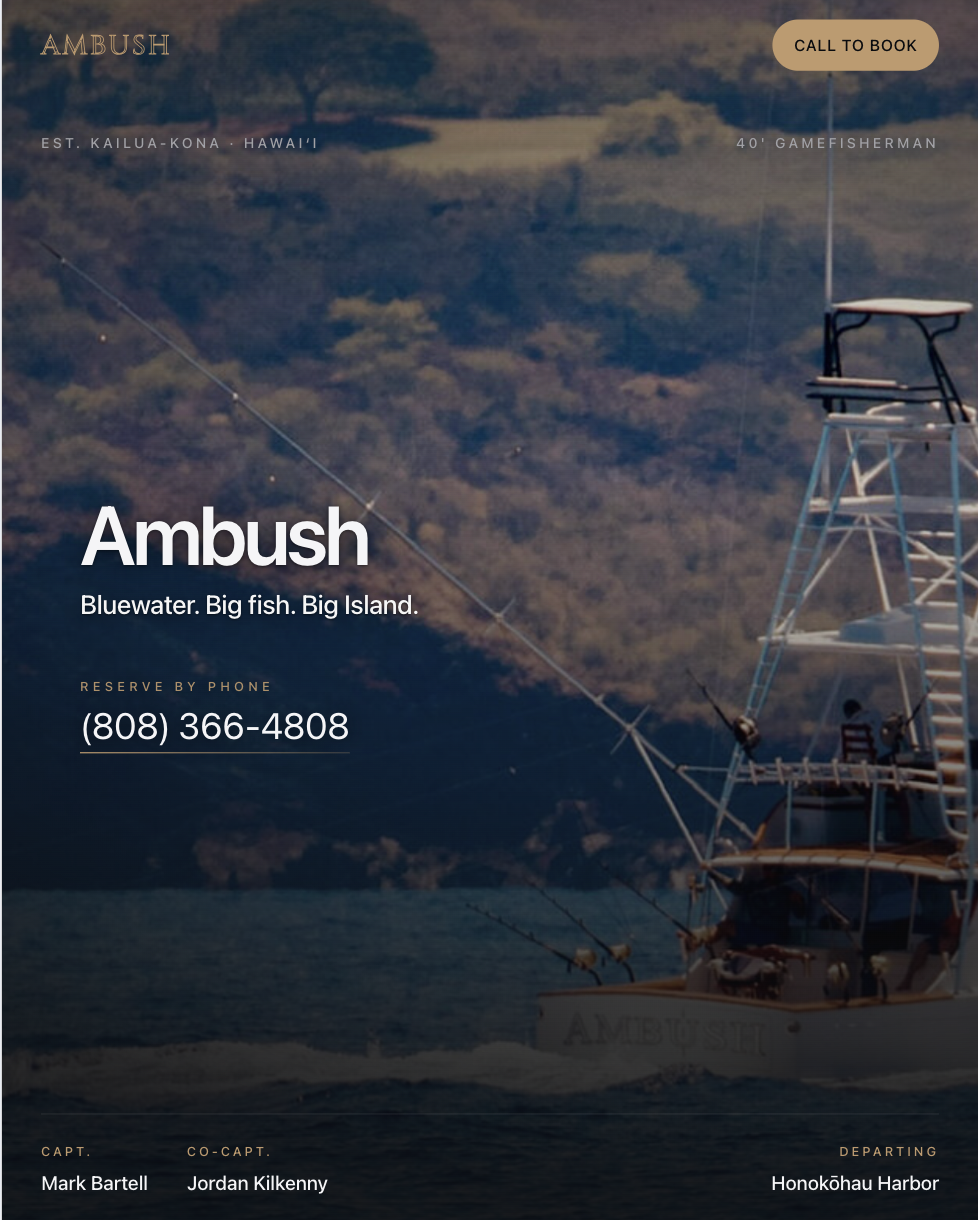
The Ambush Sportfishing website on desktop
Case Study · Ambush Sportfishing

A site as sharp as the bite.

Built for the boat and the phone. Same site, every screen.

Built for every screen

Same site. Every device.

Most charter sites break the moment a guest opens them on a phone — broken layouts, tiny buttons, no way to call. Ambush works the same on a 27-inch monitor at the dock and on a phone the night before someone's trip.

  • Tap-to-call — the captain's number is one tap from any page
  • Photos load fast — under one second on mobile data
  • Booking flow — pre-filled fields, zero pinch-to-zoom
Visit the live site
II. Overview

Ambush Sportfishing runs charters out of Kailua-Kona — clear water, blue marlin, and a captain who knows the bite better than anyone on the dock. They needed a home on the internet that felt like the boat itself: direct, capable, and serious about the work.

We built the entire site before the first conversation about money. By the time we showed them their new homepage, the booking flow, and a gallery of their best days on the water, the decision wasn't whether to hire a designer — it was whether to keep what was already theirs.

III. The process

The booking system, rebuilt around Mark.

Most charter sites either drop a guest into a generic booking widget or push them to a phone number and forget about them after the click. We did neither. We kept the phone — because that's how Kona actually books — and built a captain's-side tool that takes the twenty-minute admin shuffle that used to follow every call and collapses it into a single form Mark can fill out from the dock.

01 — The workflow

Phone first, paperwork second.

Bookings still happen by phone — Mark wanted it that way, and his guests want to hear his voice before paying $1,500. (808) 366-4808 stays one tap from every page, and the call button is tracked so we know which marketing channels actually generate rings.

What we replaced is the back-office shuffle that used to follow every call: open mail, draft a confirmation, switch to calendar, add the event, switch to Messages, type out the slip and his cell and the meeting time, switch back to mail to fix the field he forgot. Twenty minutes of context-switching per booking — multiplied by every call he took.

~20 min → ~30 sec per booking
02 — The tool

A captain-only app, on the home screen.

The /new-charter page is a private, passcode-gated PWA. Only Mark can reach it, nothing on the public site links to it, and search engines are explicitly blocked from indexing it. He installed it to his iPhone home screen with a single tap; it now opens like any native app — full screen, no browser chrome, no address bar.

The form arrives pre-filled with his usual defaults: 6 am departure, 9 hours on the water, four anglers, $1,500. About two-thirds of his charters match those exactly, so most of the time he just types a customer name and picks a date. Progressive disclosure handles the edge cases — Kids aboard?, Different slip?, Not Mark running?, Personal note? — each expands inline only when he taps it, so the form stays short for the common case.

PWA install · 4-digit unlock · auto-saving drafts
03 — The calendar

A calendar that knows the boat.

The date picker reads Mark's actual calendar in real time. Days he already has charters show a red rule. Days he's marked himself out-of-office grey out entirely. Holidays show green. Past dates are dimmed. What he sees is the boat's true availability — not what he thinks he has open from memory, which is how double-bookings happen at every charter operation in Kona.

Multi-day trips work by tapping each day in the range; the system writes one calendar event per day with the right departure time, the customer name, and the slip on every entry. So a three-day charter looks like three distinct days on the calendar — not one opaque block — and his crew sees the same picture he does when they check the morning before.

live calendar sync · conflict-aware · multi-day support
04 — The send

One tap, three outputs.

The "Send to Customer" button runs three actions atomically. One: an emailed booking confirmation — branded, with the boat, time, meeting slip, what to bring, and an ICS attachment so the guest can add it to their own calendar with a click. Two: a calendar event written straight to Mark's Google with every field already filled — customer name, party size, slip, price, payment method, fishing-license note. Three: a pre-formatted SMS returned to Mark so he can paste it straight into Messages without retyping the time, the address, or his cell number.

If any of the three fails the other two roll back, so a failed email never leaves a ghost event on the calendar. Every send is logged to a private captain's record — if a guest forwards a confirmation a week later asking about the meeting time, Mark can pull the exact send back up in seconds rather than digging through his Sent folder.

atomic · logged · ICS-attached
IV. What we built

A full site, start to finish.

Five pages, built around the rhythm of a charter day. Designed mobile-first because that's where 80% of charter bookings happen — usually on a phone, usually on the beach, often with a beer in the other hand.

Ambush Sportfishing — desktop view of the live site

— The live site, in production

V. The approach

We built first, then asked.

Ambush is the project that gave the studio its model. We had no contract, no signed brief, no kickoff call. We had a boat we'd seen, a captain we admired, and a hunch that a properly-made website would do more for them than a discovery deck ever could.

So we built the site. Over a few weeks, we made the homepage, wrote the words, designed the booking flow, chose the photographs. When it was ready, we sent the captain a link and a short note: "This is what your business could look like online. If you want it, it's yours."

He kept it. Every page, every word. That moment is what we now call the reverse pitch — and it's how every Omne Studios project begins.

VI. How Concierge shows up

For Ambush, specifically.

Concierge is shaped to each business. Here's how it's taken form for Ambush — a charter operation whose calendar moves with the season, the weather, and the fish.

Every Concierge engagement looks different. This is what it looks like for a sport-fishing operation. See the full Concierge breakdown →

VII. The results

From a group text, to a real funnel.

The numbers we're tracking — 60 to 90 days post-launch — to measure whether the site is doing its job. Real figures replace these placeholders once Google Analytics has enough signal.

Load time
0.9s
First contentful paint on mobile — measured on Cloudflare's edge.
Booking inquiries
TBD
Per month, 60 days post-launch. Baseline: ~3/mo via DM.
Mobile conversion
TBD%
Visitors who reach the booking form. Industry baseline: 1–2%.
Time saved / week
~6hr
Captain estimate — DMs and texts the site now handles upfront.

Site launched April 2026. The two TBD metrics will populate after a full booking season runs through the site (autumn 2026). The two filled metrics — load time and time saved — are measurable today.

"They sent me a finished website. I didn't have to imagine anything — it was just there, exactly how I would have wanted it if I'd known what to ask for."

Client testimonial Captain · Ambush Sportfishing

Live in production

See it in the water.

The best way to feel a website is to use it. Ambush Sportfishing is live, taking bookings, and proving the model every day.

— Next project Better Green Scapes. Coming soon